
Introduction
One of the main concerns many patients have before a hair transplant is the visible “shaved head” appearance required for surgery.
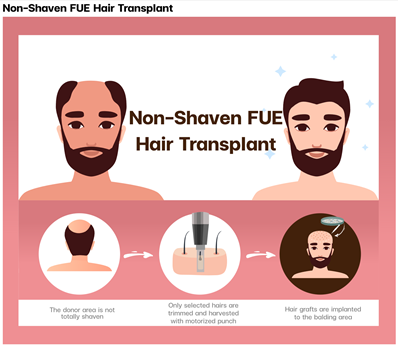
The No-Shave Hair Transplant, also known as Long Hair FUE, is a modern advancement that allows hair restoration without shaving the scalp, helping patients maintain a normal appearance and daily routine.
Long hair FUE needs special skill, expertise and instrumentation. At Venkat Center, our doctors are trained for long hair FUE
What Is Long Hair FUE?
In traditional FUE (Follicular Unit Extraction), the donor area is shaved so individual follicular units can be harvested easily.
In Long Hair FUE, the surgeon extracts complete follicular units with the full-length hair shaft intact. This keeps the surrounding donor hair long, camouflaging the extraction sites.
When implanted, these grafts retain visible hair length, giving an immediate aesthetic preview of the final result. Patients can walk out of the clinic looking nearly the same, with no obvious signs of surgery.
Who Is a Good Candidate?
Long Hair FUE is suitable for:
- Men and women wanting a discreet procedure without shaving
- Those with localized thinning or small-to-medium sessions
- Patients needing hairline refinement or touch-ups
- Individuals who must return to work quickly
- Individuals who have social engagements to attend.
For larger areas of baldness, a conventional FUE may be more practical due to the time and technical demands of long hair extraction.
Advantages
- No visible shaving of donor or recipient areas
- Immediate cosmetic appearance — grafts blend seamlessly with existing hair
- Quick recovery — most patients return to normal life within 1–2 days
- Natural results due to precise control of angle and direction
- Excellent option for professionals and public figures who prefer privacy
Step-by-Step: How the Long Hair FUE Procedure Works
- Pre-operative Assessment & Planning
- At the initial consultation we analyse your hair-loss pattern, donor hair density and quality (including donor zone stability, hair calibre, curl, and shaft length).
- For Long Hair FUE we also assess the existing hair length, donor hair shaft length and the ability to camouflage donor extraction with long surrounding hair.
- A hairline and recipient zone design is created using digital imaging and anthropometric planning, respecting your face‐shape, hairline age appropriateness, and donor reserve.
- We discuss realistic expectations, session size limitations (Long Hair FUE tends to allow fewer grafts compared to fully shaved sessions due to complexity).
- Pre-op instructions: cessation of smoking/alcohol, avoid aspirin or antiplatelets as per standard FUE perioperative protocol.
- Donor Area Preparation & Local Anaesthesia
- On the day of surgery, the donor region (typically the occipital and parietal scalp) is cleaned, disinfected and local anaesthesia administered (both donor and recipient zones). The patient remains comfortable throughout.
- Unlike traditional FUE, in Long Hair FUE the donor hair is not shaved (or minimal trimming only) — hair shafts are kept at their full length so that extraction sites are immediately camouflaged by adjacent hairs.
- The donor hair may be gently separated/parted to visualise extraction zones while keeping the long hair intact; this demands high coordination and meticulous technique.
- Graft Extraction (Harvesting)
- Using a fine micro-punch (typically in the 0.8–0.9 mm range, depending on hair calibre and donor skin thickness) under magnification, individual follicular units are excised.
- In Long Hair FUE the challenge is higher: the long hair shaft must pass through the punch and be extracted intact without shearing, tangling or damaging the graft. This often requires specialised instrumentation or modified punch designs.
- The surgeon must maintain awareness of the hair’s angulation, curl, depth of insertion and the surrounding long hair shaft — extraction is slower and more laborious than standard FUE.
- The harvested grafts (with their intact long shafts) are immediately placed in a chilled, physiologic holding solution to maintain viability
- Graft Preparation & Sorting
- Under microscopic magnification the grafts are trimmed (if required at the root end only), separated by follicular unit type (1-hair, 2-hair, 3-hair units), and placed in graft holding solutions.
- Special care is taken with the long hair shafts to avoid tangling and trauma; orientation is preserved so the hair shaft direction and curl are known prior to implantation.
- This step influences survival rate and aesthetic result — good graft handling is essential.
- Recipient Site Creation (Implantation Strategy)
- Tiny recipient slits are made in the thinning or bald areas using fine blades (e.g., sapphire blades) or implanter pens; the key is to replicate the natural direction, angulation, density and flow of the existing hair.
- Because the grafts have long hair shafts visible, the surgeon and team can visualise immediate cosmetic coverage and more accurately blend with surrounding hair — this is a unique advantage of Long Hair FUE.
- The size of the recipient slits is carefully calibrated to accommodate the grafts without trauma, ensuring good perfusion and minimal trauma.
- Graft Implantation
- Using fine forceps or implanters, the grafts (with long hair shafts) are placed into the recipient slits. Placement must respect the natural hairline, temporal angle, crown swirl, and density planning.
- Because the hair shafts are long, the visual effect of placement is immediate: you can see coverage and orientation instantly. This aids in achieving natural, aesthetic results right away.
- Post-implantation, the scalp is assessed for uniform distribution, minimal “standing up” of grafts, good closure of recipient sites and no undue trauma.
- Immediate Post-operative Care
- Donor and recipient area dressings are done; in many cases minimal bandaging is required. Because the donor hair is long, the extraction sites are already camouflaged.
- Patients are instructed on initial care: gentle head elevation, avoid intense physical activity, keep the scalp clean, avoid hats or garments that rub grafts.
- Many patients return to office work within 24–48 hours, thanks to the minimal visible impact of the procedure when done well.
- Short-Term Recovery & Monitoring
- In the first 1–2 weeks expect tiny crusts in extraction and implantation sites, mild swelling (especially the forehead), and the long-transplanted hair shafts give a preview of the final look.
- Around weeks 2–4 a shedding phase (commonly called “shock loss”) occurs — transplanted hairs with their long shafts will shed the visible hair, but the follicle remains. Regrowth begins thereafter.
- During this time donor area healing is monitored: extraction sites heal rapidly when done meticulously; because the hair was not shaved, there is virtually no visible donor-zone disturbance.
- Long-Term Growth Phase & Final Results
- New hair growth typically begins from month 3 onward, with visible improvement by month 6, and full aesthetic maturation by month 12. Standard graft survival rates in experienced hands exceed 90 % in FUE.
- In the case of Long Hair FUE, the initial long shafts give an immediate cosmetic benefit, and the gradual natural regrowth complements that initial look.
- At the end of the process the donor area remains camouflaged, the hairline and density look natural, and there is minimal sign that surgery occurred.
Special Technical Considerations for Long Hair FUE
- Instrumentation: Standard FUE punches may not accommodate long hair shafts efficiently; specialized “long‐hair” punches/traction systems (e.g., flared-lumen punch designs) help prevent shaft shearing and graft trauma.
- Surgical Time: Because each graft extraction/implantation is more delicate and longer, Long Hair FUE sessions may require more time and may yield fewer grafts per session compared to shaved FUE.
- Donor Management: Careful spacing of extraction sites is needed to maintain donor stability, especially since the surrounding long hair must hide extraction. So mega sessions are difficult.
- Graft Handling: Protecting the hair shaft from kinking, twisting or micro shearing is key; long shafts are more prone to tangling, the surgical team must be experienced.
- Transection is higher in long hair FUE and hence large sessions are difficult
- Patient Selection: Best suited for patients with sufficient donor quantity, and desire for minimal visible downtime. Very large bald areas may be less efficient with long hair method.
Summary
By following a carefully orchestrated sequence—from assessment and donor preparation, to long hair graft extraction, precision implantation, and specialized postoperative care—the. Long Hair FUE technique enables a truly discreet hair transplant. Patients maintain their hairstyle appearance, minimize visible signs of surgery, and can return to daily life with confidence, while we engineer results that are biologically robust and aesthetically natural.
At the Venkat Centre
At the Venkat Centre for Aesthetic Health, Bangalore, we have extensive experience with FUE, Long Hair FUE, and advanced hair restoration techniques.
Using microscopic magnification and precise instrumentation, we ensure high graft survival, natural density, and aesthetic harmony.
If you wish to restore your hair discreetly and continue your routine without downtime, Long Hair FUE may be the ideal solution.
