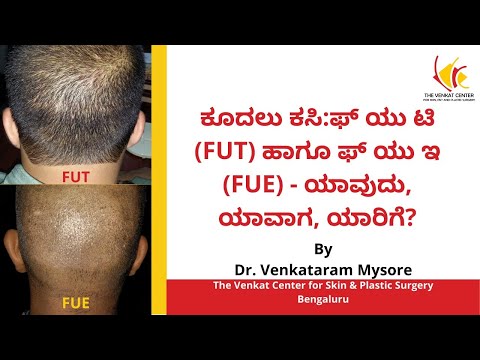
Hair transplantation has become a beacon of hope for all out there who dream of a head full of hair. Both the techniques of FUT hair transplant and FUE hair transplant have proven to be equally efficacious in treatment. FUE vs FUT, the question is which to choose.
Technically they differ only in the harvesting of grafts from the donor site.
There is no difference in how grafts are implanted. The primary difference between hair transplantation methods lies in the donor area. Let us explore the key points that differentiate them.
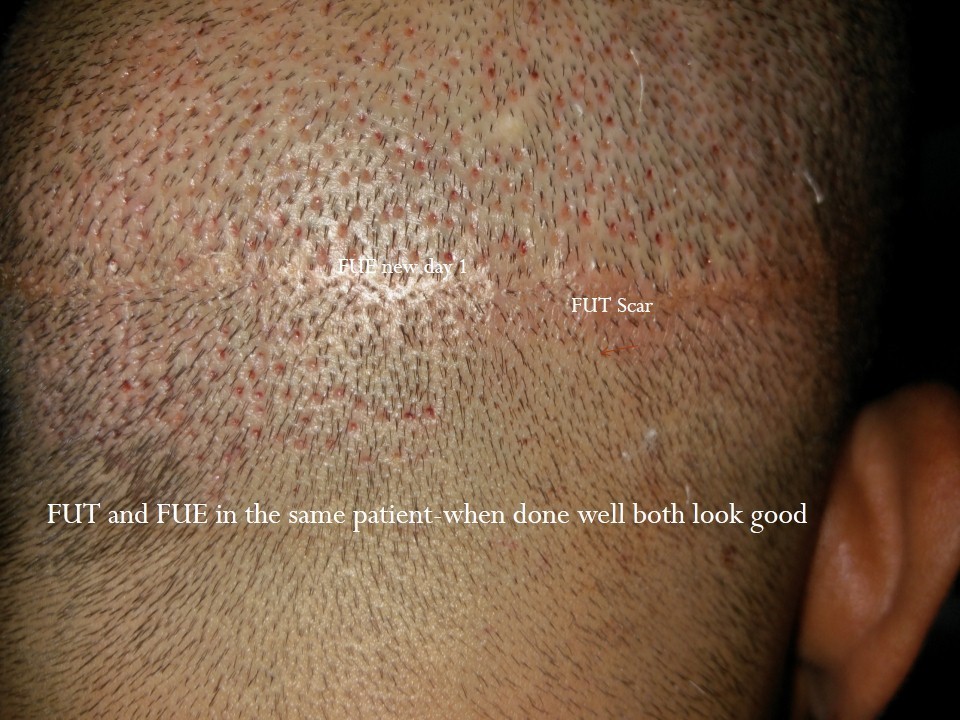
When considering hair transplant options, it’s important to weigh the pros and cons of FUE and FUT techniques. FUE offers advantages such as minimal scarring, quicker recovery, and precise graft placement. However, FUT can provide a higher graft count in one session and may be more cost-effective for extensive restoration, though it does leave a linear scar. Consulting with a hair transplant specialist is key to determining which approach aligns best with your specific needs and preferences in the FUE vs FUT pros and cons comparison.
FUT: Involves single strip method with elliptical excision of donor followed by suturing.
| Advantages | Disadvantages |
| Cheaper | Stitches required |
| Shorter operative time | May leave a scar |
| Larger sessions are easier | Longer healing time |
| A repeat FUT/FUE can be done in future | More discomfort |
| Dissection occurs under microscopy | |
| Can be followed by FUE if needed but not vice versa |
FUE: Involves extraction of grafts as individual follicular units.
| Advantages | Disadvantages |
| Minimal recovery time – JUST ONE DAY | More expensive |
| Can sport a short hairstyle | Long operative period and hence tiring for the patient. |
| Tiny dot-like scars over donor areas | The number of grafts extracted per day is limited therefore extensive baldness may require multiple sessions |
| No stitches required | Once FUE is done, a second FUE/FUT cannot be done in future |
| No need for repeat visits for stitch removal | Shaving / Trimming of the donor – required |
| Shorter healing time | Difficult for larger areas |
Having seen the benefits and limitations of each procedure, now let us take a look at how they fare against each other.
| Features | FUT | FUE |
| Shaving /Trimming of head | not needed | needed |
| Cost | cheaper | expensive |
| Large areas | possible | difficult |
| Stitches required | Yes | No |
| Visible scarring with short hair at the back | May be present | Tiny dot-like scars |
| Pain after the procedure | Minor | None |
| Time required for the procedure | Short | Longer |
| Healing time: donor area | 2-3 weeks | Approximately 1 week |
| Healing time: recipient area | Around 2 weeks | 10–14 days |
| Amount of time after which the patient may return to work | Next day | Usually the next day, but with some discomfort for up to two weeks. |
| Natural results | Yes | Yes |
| Transection rate (grafts damaged during extraction) | Varies 1–2% | 2-5% |
They both are equally efficacious in regrowth and it’s not possible to tell one from another as the technique of implanting the hair follicles at the recipient site is the same for both.
Opting a method also depends on other factors irrespective of the techniques. They are:
The surgeon needs to consider all facts and then decide what is best for the patient. One method does not fit everyone. So a patient has to choose a clinic which can perform all methods.
Things to note:
If you have a large area of baldness, there are two options;
Some people wish to cover an entire area in one visit; this can be done by a Giga session, which is done by taking hairs by different methods not only from the scalp but also other areas. Large sessions over 4000-8000 grafts can be done as follows:
Body hair can yield depending on availability. However, this needs stamina and a big budget and therefore is applicable for select patients only.
Please note that this advice is general. Precise estimation would be possible by personal examination; this advice is given as a guide to help you decide on different options. For further discussion, please email at drvenkat@venkatcenter.com or skinhair@venkatcenter.com.
In our opinion, for the Indian situation, for patients with a limited budget, FUT is the best method as it is cheaper, more convenient and gives outstanding results.
Despite this, FUE holds an attraction to many patients who are apprehensive of the FUT method because of “skin being removed”. In such patients, and for those who wish to have short hair, those with adequate financial resources, and limited bald area, FUE can be done, up to about 2000 grafts.
Beyond 2000 grafts, FUT is better- if the patient still wishes to have FUE, FUE will have to be combined with body hair. Body hair in our opinion is inferior to scalp hair and is therefore recommended only when scalp hair is not available.
In our opinion, the true value of these new techniques lies in the increased options they provide for the transplant team. They are especially beneficial for individuals with a poor donor area and those seeking to undergo multiple sessions, such as 3,4 or 5 sessions. They help us to transplant more grafts; e.g. By combining FUT, FUE, and BHT, it is possible to transplant even beyond 4500 grafts in one session: 2500 by FUT, 1000-1500 by FUE, and another 500-750 by BHT, over a period of 3-4 days.
This is particularly applicable for those with large areas of baldness, who wish to complete the surgery in one session, such as those coming from foreign countries. Of course, this would mean a heavy cost, above Rs 3 lakhs.
It should be emphasised that despite all the hype on internet sites, 90% of all hair transplants in the world are done by FUT only. FUE accounts for only 10% of all transplants because of its high cost. This is the case with us also – we have many patients who seek FUE after reading on the internet, and then change their minds to have FUT after knowing full details.
Great things are done by a series of small things brought together.
The decision is best made by answering the following questions:
Dr. Venkataram Mysore was one of the first surgeons to learn this technique in the country. He is an expert in FUT and is one of the most respected Hair Transplant experts in the world. He has edited the first Indian textbook on the subject and is the first and only Indian Dermatologist to be made a fellow of the International Society of Hair Restoration Surgeons.